As two of the top premium vacuum cleaner manufacturers, both Miele and Sebo vacuums are built around some of the same foundational premises. One of these is that a high-quality, properly fitted bag should be an active part of how the machine cleans and filters. The bag works in concert with the pre-motor filter and exhaust filter to make up a sealed system, and when you use the right bag and change it on schedule, the machine performs as it was designed to. If you use the wrong bag, or stretch a full bag further than it wants to go, you’re working against the engineering.
The good news is that both brands keep things relatively simple, once you know your model series. Neither Sebo nor Miele expects you to memorize a confusing matrix of codes. The bags are organized by vacuum family, and once you know which family your machine belongs to, the right bag is obvious. If you’re still deciding between these two brands entirely, our comparison of Miele and Sebo vacuum cleaners is a good place to start.
Here’s just about everything you need to know about finding compatible replacement bags for vacuum cleaners for both brands: what fits what, what the differences between variants are, and a few other things worth knowing about.
Tip: Vacuum lineups evolve, models get updated, bag series get revised, and compatibility details can change over time. The information in this guide reflects current specifications to the best of our knowledge at the time of this writing, but it’s always worth a quick confirmation with your dealer or a check of the manufacturer’s current documentation. A specialty vacuum store like Edison Vacuum can match the right bag to your machine in about 30 seconds, so for older or less common models especially, it’s worth confirming with the vacuum experts.
Miele Replacement Bags

Miele produces bags in four main types for their residential lineup: FJM, GN, U, and KK. However, the 2 you’re likely to encounter most often are FJM and GN, which cover the entire canister range. U bags cover the upright line. KK bags cover stick and handheld models and aren’t discussed in depth here since they’re a different product category.
One useful detail to know about Miele’s bag system is that every box of genuine Miele bags includes a motor protection filter and an exhaust filter in addition to the bags themselves. It’s recommended to replace those filters every 4 bags. It’s easy to forget, but keeping up with the filter rotation is part of how you get 20 years+ out of a Miele motor.
Miele AirClean FJM Bags
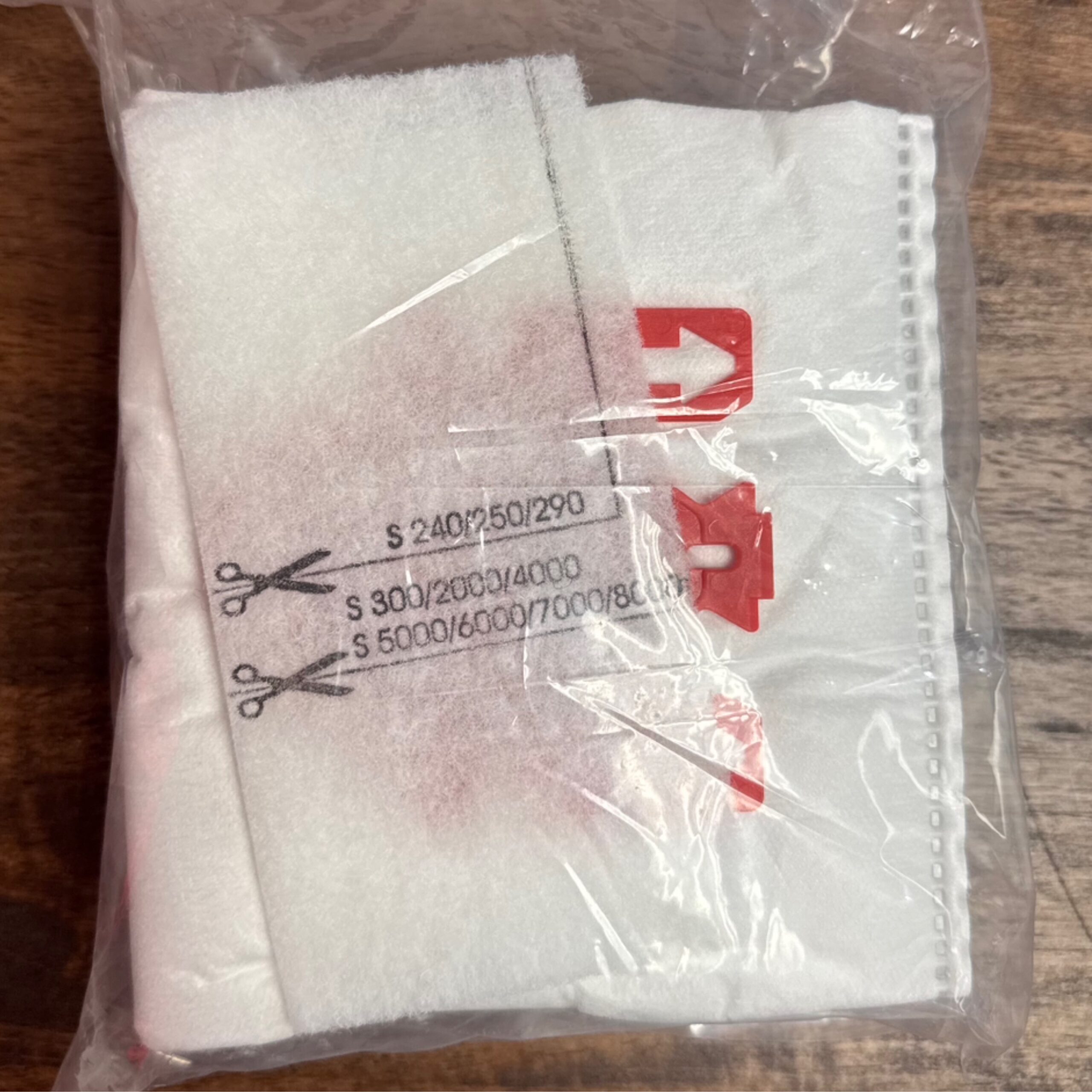
FJM bags are their smaller canister bag — 3.7-quart capacity, identified by a red collar tab — and they fit the compact end of Miele’s canister lineup. If your machine is a Complete C1, Compact C1, or Compact C2, FJM is your bag. They also fit a wide range of older Miele S-series canisters in the S4000–S4999 and S6000–S6999 ranges, along with earlier S-series models including the S300i–S399, S500–S578, and S700–S799 families.
The standard AirClean FJM comes four bags per box. It’s Miele’s multi-layer filtration material — not paper in the traditional sense, but a dense synthetic microfiber construction that filters fine particles efficiently throughout the bag’s fill cycle.
Note: the Classic C1 and Complete C1 are different machines — the Complete C1 takes FJM bags, the Classic C1 takes GN.
Miele FJM HEPA Bags (9-Count)
The HEPA variant of the FJM bag fits the same machines as the standard AirClean FJM, but adds a HEPA-rated filtration collar that enhances particle capture at the bag’s intake point. For households with allergy or asthma concerns, Miele FJM HEPA bags offer an additional layer of protection beyond what the standard bag provides. The 9-count packaging makes it a more economical purchase per bag for households that vacuum frequently or go through bags at a faster rate.
Miele AirClean GN Bags
Miele GN bags are their larger canister bag — 4.76-quart capacity, identified by a blue collar tab — and they cover the full-sized end of the canister lineup. If your machine is a Classic C1, Complete C2, or any model in the Complete C3 series (including the Cat & Dog, HomeCare, and Marin configurations), GN is your bag. They also fit a long list of older Miele canisters: S2000–S2999, S5000–S5999, S600–S658, S800–S899, and S8000–S8999.
It’s worth knowing that FJM and GN bags share the same physical collar tab design, which means either bag will physically fit into either machine — but they’re not interchangeable for regular use. The GN bag, being larger, won’t fill and seal correctly in a compact canister body designed for the FJM. For day-to-day use, always use the bag specified for your model.
Miele GN Bags (Bulk) — 9-Pack
For GN-compatible machines, a quality generic 9-pack is a good option for buying Miele GN vacuum bags in bulk, especially for households that vacuum frequently and go through bags at a faster clip. Not all third-party bags are created equal — the ones worth buying are multi-layer constructions with a proper collar seal, not single-layer paper with a pressed-cardboard tab. A poorly made generic bag can compromise airflow, allow fine dust to pass through into the motor compartment, and in the worst cases, affect the machine’s filtration performance in ways that compound over time. A well-made one works perfectly fine. Worth knowing the difference before you buy based on price alone.
Miele AirClean U Bags
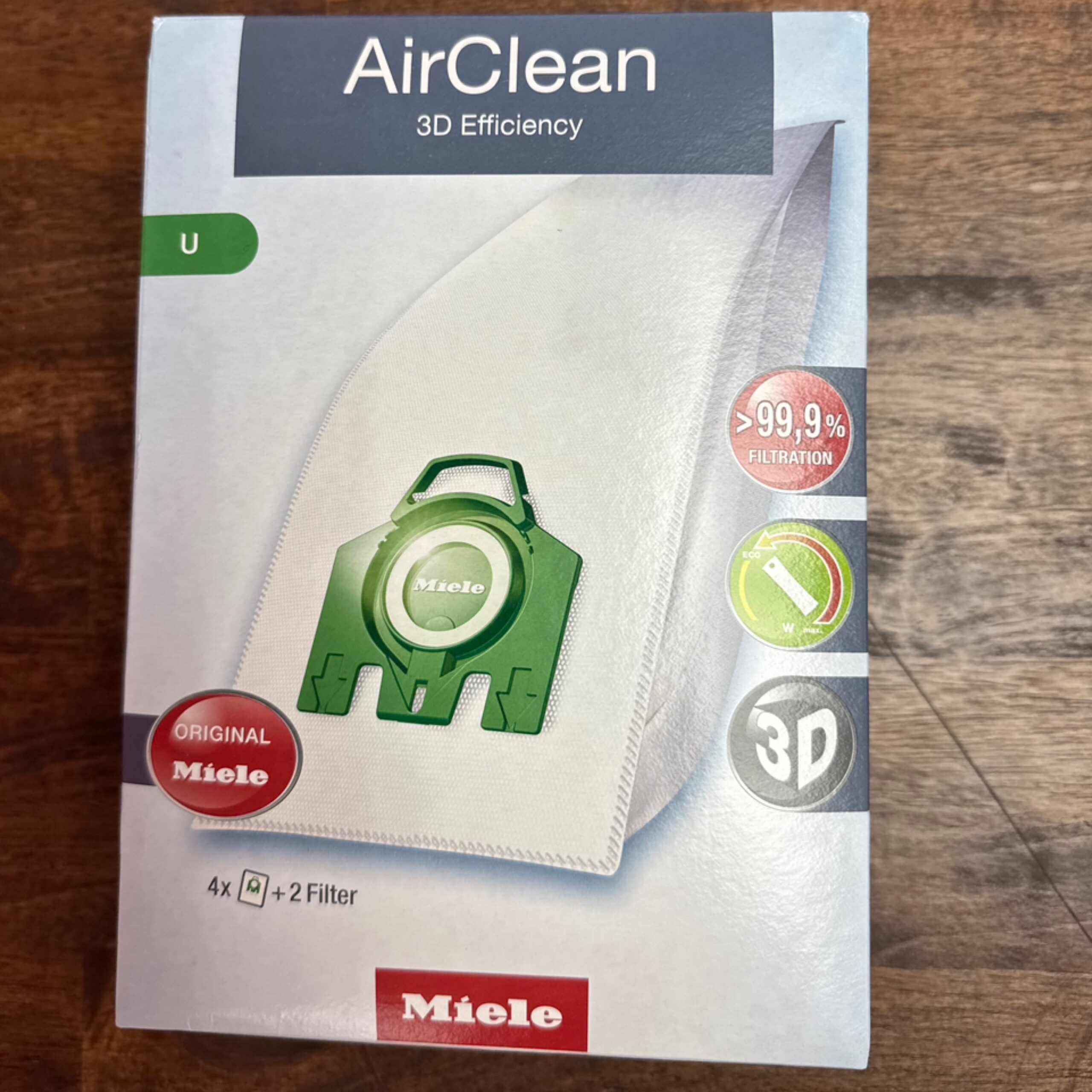
Miele Airclean U Bags are designed specifically for Miele’s upright vacuum cleaners — the Dynamic U1 series and the older S7 upright family. The U bag is a narrower, more elongated form factor than the canister bags, designed to fit within the upright’s housing rather than a separate canister body. If you own a Miele upright rather than a canister, this is your bag — and it’s not interchangeable with FJM or GN bags in any direction.
Miele Bag Quick Reference:
FJM (red tab) → Complete C1, Compact C1, Compact C2, and older S4000/S6000-range canisters
GN (blue tab) → Classic C1, Complete C2, Complete C3, and older S2000/S5000/S8000-range canisters
U → Dynamic U1 uprights and S7-series uprights
Not sure which series your machine is? The model number is on a label on the underside or back of the canister body.
Sebo Replacement Bags

Sebo’s bag lineup follows the same logic as their machine lineup: each vacuum series has its own bag, and Sebo makes it easy to identify the right one because the series names match directly. The bags themselves are a meaningful part of Sebo’s filtration story — their AeraPure multi-layer design uses electrostatically charged microfiber that captures fine particles throughout the fill cycle, and the self-sealing cap on the collar keeps debris locked inside the bag during removal so it doesn’t escape back into the air.
All Sebo bags are top-fill designs, meaning debris enters from the top, settles toward the bottom, and air exits through the bag’s sides. This keeps the airflow path clean even as the bag fills, which is part of why Sebo machines maintain consistent performance until the bag is genuinely full rather than dropping off as the bag loads up.
Sebo X/G/C/300/350 Bags
This is the Sebo replacement bag style for Sebo’s flagship upright lineup — the Automatic X series (including the X4, X7, and X8), the Essential G series uprights, and the AirBelt C series canisters. It also fits older Sebo uprights in the 300, 350, and 370 families, which means long-time Sebo owners running older machines can still source bags easily through the same SKU.
If you own a current Sebo X7 or X8, this is your bag. It’s worth noting that Sebo offers 2 service box configurations for the X series. One of these is for older X4/X5 models, and they also offer a separate version for the X7 and X8. So if you’re buying a service box (which includes bags plus a micro filter and exhaust filter), confirm which version matches your machine.
Sebo Felix Bags
Sebo Felix bags fit all Felix and Dart upright models — one bag type covers the entire Felix family regardless of year or configuration. The Felix uses a detachable suction unit that doubles as a handheld, which gives it a slightly different internal geometry than the X-series uprights, and the bag is sized and shaped accordingly. Felix bags are not interchangeable with X-series bags.
Sebo D Bags
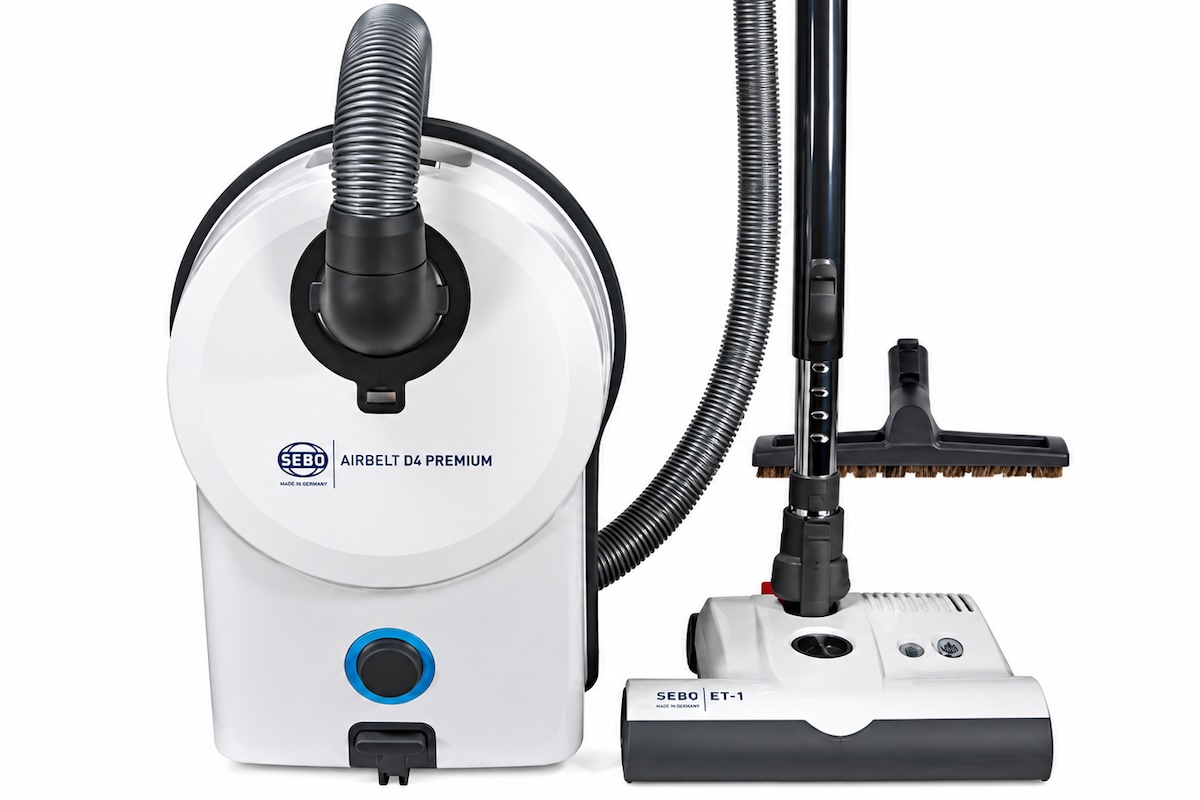
D bags fit the Sebo AirBelt D series canisters — the D1 and D4. The D4 is Sebo’s most capable canister, with a larger bag capacity than the E and K series (up to 1.5 gallons on the D4). D bags are sized for that larger body and deliver the full four-stage S-Class filtration performance the D series is built around.
Sebo E Bags
E bags fit the Sebo AirBelt E series canisters — the E1, E2, and E3. The E series sits above the K series in Sebo’s canister lineup, with a larger capacity and broader floorhead selection. E bags are not interchangeable with K or D bags.
Sebo K Bags
K bags fit the Sebo AirBelt K series canisters — the K1, K2, and K3. The K series is Sebo’s compact canister, the AirBelt design giving it a distinctive wraparound bumper that protects furniture and walls during cleaning. K bags are sized for the K canister’s body and are specific to that series.
Sebo Softcase Bags
Softcase bags are specific to the Sebo SoftCase CE-12 model — a canister with a fabric outer housing rather than the hard-shell AirBelt body used on the rest of the canister lineup. The Softcase bag is a multi-layer microfiber construction rather than the standard format, designed specifically for the CE-12’s geometry. If you own a CE-12, this is your bag — and it won’t fit any other Sebo model, nor will any other Sebo replacement bag fit the CE-12.
Sebo Bag Quick Reference:
X/G/C/300/350 → Automatic X4, X7, X8; Essential G series; AirBelt C series; older 300/350/370 uprights
Felix → All Felix and Dart upright models
K → AirBelt K1, K2, K3 canisters
E → AirBelt E1, E2, E3 canisters
D → AirBelt D1, D4 canisters
Softcase → SoftCase CE-12 canister only
A Note on Third Party vs OEM Replacement Bags
For both Sebo and Miele, the bag is an integral component of a sealed filtration system, not just a disposable liner. Both manufacturers engineer their bags to work in concert with the machine’s airflow path, the pre-motor filter, and the exhaust filter. A genuine bag from either brand is a multi-layer construction with a precisely fitted collar seal, designed so that when the bag is inserted and the compartment is closed, no air bypasses the bag and reaches the motor unfiltered.
Naturally, third-party bags can vary considerably in quality. The best generic compatible replacement bags are constructed from quality microfiber materials with a proper collar seal and perform well in practice. Lower-quality generics use thinner materials and less precise collar geometry, which can allow fine dust to pass through into the motor compartment, reduce effective airflow, and over time cause wear that a genuine bag would have prevented. Thus, for both brands, genuine or generic bags purchased through a local/specialty vacuum shop is generally going to be a safer choice. If cost per bag is a consideration, buying in larger packs, like the 9-count FJM or GN for Miele, can bring the per-bag cost down meaningfully.
How Often Should You Change the Bag?
Both Miele and Sebo build bag-full indicators into their machines — a sensor or indicator that alerts you when airflow restriction reaches a threshold that warrants a bag change. For most households vacuuming once or twice a week, that works out to roughly every one to three months depending on home size, floor type, and how much debris the machine is picking up.
The practical advice from both brands and experienced vacuum dealers is the same: change the bag when the indicator says to, not before and not long after. Running a machine with a full or overfull bag forces the motor to work harder against restricted airflow, which generates heat and accelerates wear over time. The bags themselves are a small ongoing cost relative to the machine, roughly the equivalent of skipping oil changes on a car you paid a lot of money for because oil is cheaper than the car. Treating replacement bags as a consumable to stretch as far as possible is a false economy on equipment worth protecting.
For Miele specifically: remember to replace the motor protection filter and exhaust filter every four bags, since those come included in every genuine Miele bag box and the rotation is built into the packaging cadence by design.