If you’ve narrowed your search down to Miele and Sebo, you’ve already done something right. Both are German-engineered, both are built to last decades rather than years, and both sit comfortably at the top of what the vacuum cleaner world has to offer.
That’s a genuinely short list to be on. The broader vacuum market is crowded with machines that make ambitious promises and underdeliver within a few years, and sorting through all of it to arrive at two German-engineered brands with decades-long track records usually takes either a lot of research or a conversation at the local vacuum cleaner shop with someone who really knows the category.
This guide walks through everything that meaningfully separates these two brands: filtration, floor type performance, design philosophy, noise, ease of maintenance, price, and long-term ownership. By the end, you’ll have a clear sense of which direction makes more sense for you — and you genuinely can’t go wrong with either one. Both manufacturers truly produce some of the top buy it for life vacuum cleaners.
Quick Answer: Miele tends to shine for households that want maximum versatility, whisper-quiet operation, and a wide range of cleaning attachments — especially on mixed hard floor and carpet homes. Sebo is the go-to for deep carpet performance, professional-grade durability, and a straightforward cleaning experience that carpet manufacturers themselves frequently recommend. Both are exceptional. The “better” one depends entirely on what you’re cleaning.
The Brands, in Brief
Miele: Over 125 Years of German Craftsmanship
Miele was founded in 1899 in Gütersloh, Germany, originally producing cream separators and butter churns before pivoting to household appliances. On the lid of their very first product, they inscribed a small globe and the words immer besser — “always better.” It’s the kind of detail that sounds like it was invented later for a brand retrospective, except it actually happened.
The company has remained family-owned through 4 generations of the Miele and Zinkann families, which goes a long way toward explaining why their engineering priorities have stayed so consistent over the decades: build it right, build it to last, and never cut corners on materials.

Their vacuum lineup today spans canisters (the well-loved C-series), uprights, stick vacs, and robot vacuums. In the premium canister category specifically — the C2 and C3 Complete lines — Miele has earned something close to a cult following among people who take floor care seriously. The company tests their motors to 20 years of average household use before a product ships, which is an unusual commitment in a market full of planned obsolescence.
Sebo: The Professional’s Choice That Works Just as Well at Home
Sebo was founded in 1978 in Erkrath Velbert, Germany, and over the decades has built one of the most loyal customer bases in the industry, despite being far less aggressively marketed than its competitors in North America. In the UK and across Europe, Sebo is a household name. In the US, it tends to either be discovered by people who asked a really good salesperson at an independent vacuum shop, or who stumbled onto the brand while going down a vacuum cleaner history research rabbit hole.
What sets Sebo apart from the jump is their relationship with the professional cleaning world. Their commercial uprights are used in hotels, hospitals, and office buildings worldwide, and that same engineering DNA runs straight through their residential models. The Sebo Felix, the X-series uprights, and the D and E-series canisters are all built around the idea that a vacuum should require as little fuss as possible while delivering consistent, reliable results over many years.
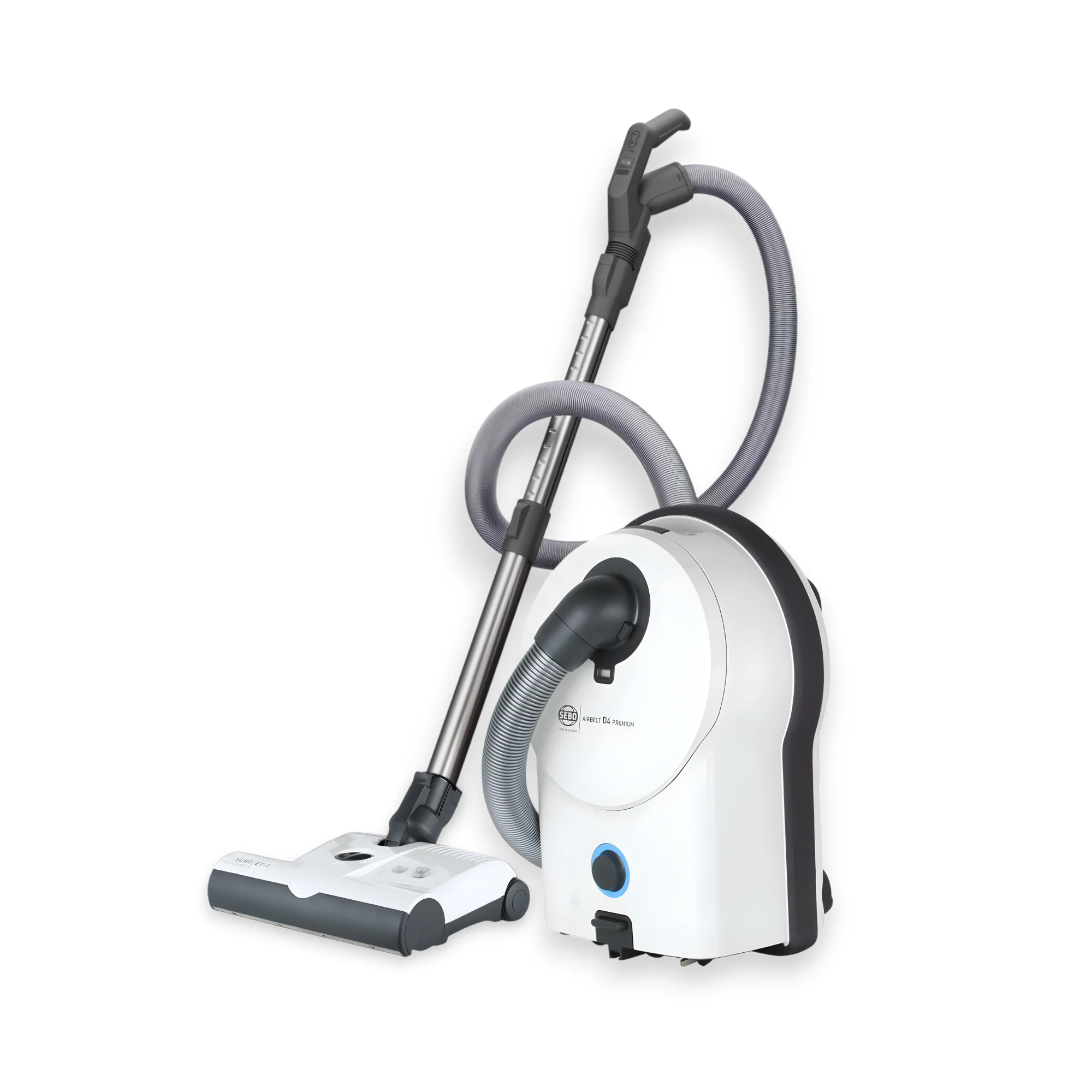
Now it’s also worth noting here that several major carpet manufacturers — including some who test and certify cleaning equipment — specifically recommend Sebo uprights for maintaining carpet warranties. That’s not a marketing claim; it’s a practical endorsement from people whose products depend on vacuums doing their job correctly.
Design Philosophy: Where These Two Brands Actually Differ
On paper, Miele and Sebo share a lot. Both are bagged (Miele also makes bagless models, but their bagged machines are the ones with the long track records). Both use high-quality filtration. Both are German-made with strong warranties. The differences are more about how they approach the job.
Miele leans into versatility and refinement. Their canisters, in particular, are designed to handle a wide range of surfaces with the right attachment, and the brand invests heavily in the accessory ecosystem — motorized floorheads for carpet, parquet brushes for hardwood, upholstery tools, crevice wands, mini turbines for pet hair, and more. The machine itself is elegant, relatively compact, and built to integrate into a home seamlessly.
Sebo leans into durability and carpet-specific performance. Their uprights especially are engineered from the ground up to do one thing extremely well: clean carpet. The brush roll design, the automatic height adjustment on models like the X7, the belt protection system, the ease of clearing blockages — every mechanical decision points toward a machine that will work reliably in demanding conditions without needing much from you in return.
Filtration: Both Are Excellent, With Some Nuance
Allergy sufferers and households with pets often put filtration at the top of their list, and both of these German brands take it seriously.
Miele Filtration
Miele’s higher-end models — especially in the C3 Complete line — include HEPA AirClean filtration as standard. Their sealed system is genuinely impressive: the combination of their AirClean bags (which self-seal when removed, so dust doesn’t escape during bag changes) and the HEPA exhaust filter means the air leaving the machine is measurably cleaner than the air that went in. For anyone with asthma, severe allergies, or a household full of pet dander, this is a real differentiator.
The bag quality itself is part of the filtration story. Miele’s FJM, GN, and U-style bags use a multi-layer material that holds fine particulates efficiently, and the bags tend to hold a good amount of debris before performance starts to drop.
Sebo Filtration
Sebo’s approach to filtration is similarly thorough. Their machines use a three-stage filtration path: the bag captures the bulk of debris, a fine motor protection filter sits before the motor, and an exhaust filter (HEPA-rated on most current models) handles the outflow. The system is sealed well enough that Sebo machines also carry approval from allergy and asthma organizations in various markets.
Their bags are thick and durable — notably so, compared to many competitors — and the machines are designed so that changing the bag is clean and simple, with minimal dust exposure during the process.
Filtration Takeaway: Both brands deliver strong filtration that performs well for allergy-sensitive households. Miele’s self-sealing bag system is a genuine convenience advantage during bag changes. Sebo’s filtration is equally capable and slightly more forgiving if you’re occasionally slow to change the bag before it’s completely full.
Carpet Performance: Where Sebo Has a Clear Edge
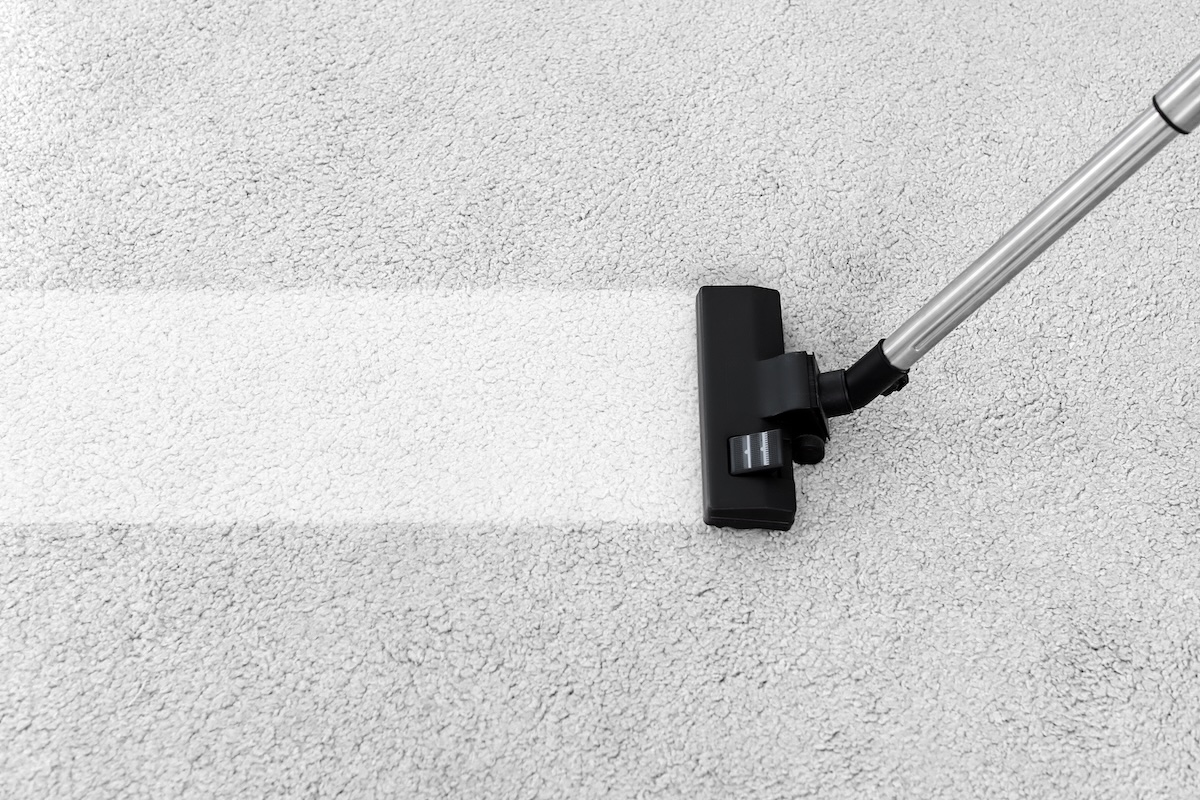
If carpet (especially thick, plush, or high-pile carpet) is your primary concern, Sebo’s upright models are hard to argue against.
The Sebo X-series uprights use a brush roll that’s specifically calibrated for deep carpet agitation. The automatic height adjustment (standard on the X7 and available across the line) means the machine continuously optimizes brush roll depth as you move between area rugs, hallway runners, and wall-to-wall carpet without any manual intervention. This sounds like a small thing until you’ve spent time fighting with a vacuum that bogs down on a thick rug or chatters across a low-pile runner.
The belt protection system is another feature carpet owners will appreciate. Sebo’s uprights are designed to stop the brush roll automatically if something gets caught — a sock, a fringe, a piece of string — rather than burning through a belt. Replacing belts on most uprights is an annoying, manual process; Sebo largely removes that friction.
That said, Miele’s canisters and uprights and the Dynamic U1 line perform well on carpet and hold their own respectably, but the consensus among independent reviewers and longtime owners is that Sebo’s carpet-specific engineering gives it a meaningful advantage in deep-pile and high-traffic carpeted spaces.
Hard Floor and Mixed-Surface Performance: Miele’s Strength
Flip the scenario to hardwood, tile, LVP, or a home that’s primarily hard floors with some area rugs, and Miele’s canister models become the more obvious choice.
The Miele C3 Complete with an electrobrush or parquet floorhead is one of the most effective hard floor cleaning setups available at any price point. The low-vibration motor, the well-designed suction control (adjustable right on the handle on premium models), and the variety of specialized floor tools let you tailor the machine to each surface. On raw hardwood that scratches easily, the parquet brush with its row of soft bristles moves debris gently and completely. On tile grout or textured stone, a different floorhead engages the debris differently.
Canisters are also simply more practical for homes with lots of furniture, stairs, narrow hallways, or rooms that require getting under low-clearance pieces. The long wand, the flexible hose, and the lightweight cleaning head make above-floor cleaning — baseboards, shelves, upholstery, curtains — genuinely easy rather than a workout.
Surface Type Takeaway: Primarily carpeted home with thick or high-pile rugs? Sebo uprights are where the engineering points. Primarily hard floors, or a mix of surfaces where versatility counts? Miele canisters handle the range more elegantly.
Uprights vs. Canisters
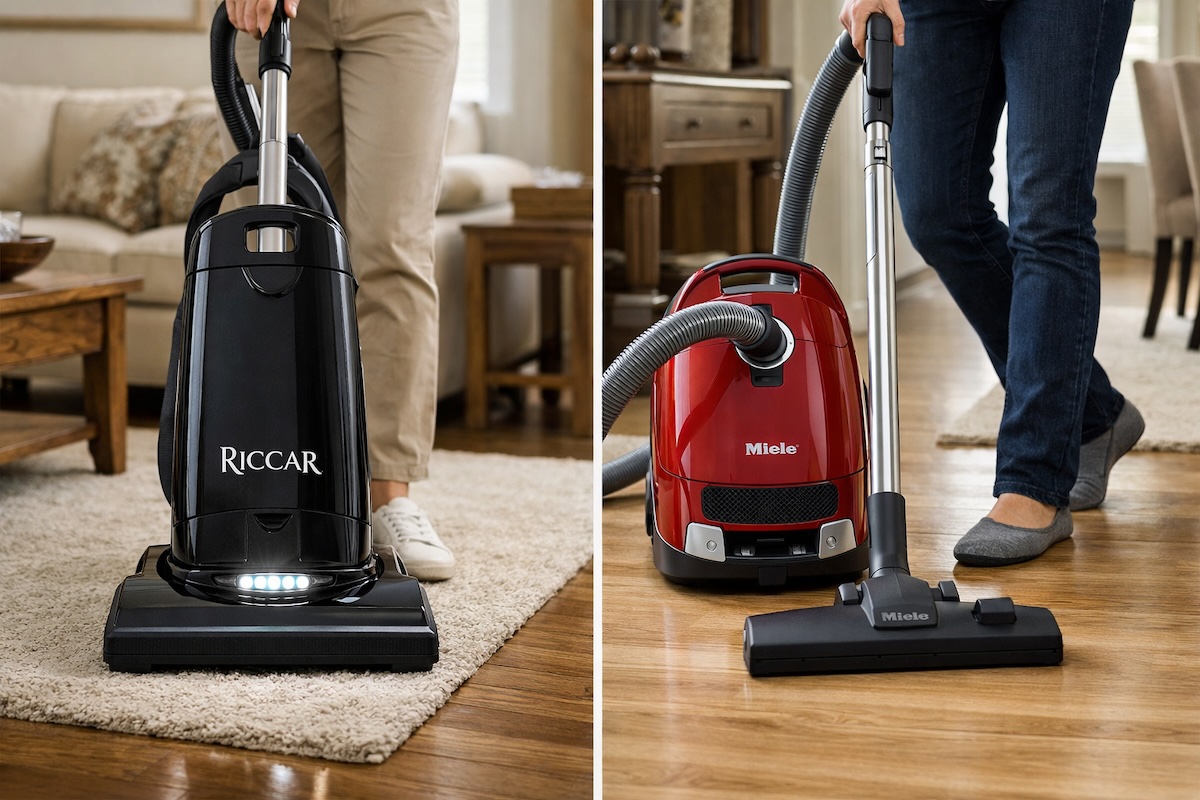
As a general rule, uprights generally perform well on carpet. The motorized brush roll is built into the cleaning head and sits closer to the floor, which translates to better agitation and deeper fiber cleaning. They’re also typically easier to store and more intuitive to push through a room. Canisters trade that highly carpet-specific advantage for versatility: the separation of motor and cleaning head makes above-floor work, hard floors, stairs, and tight spaces considerably more manageable, and swapping between attachments is, typically, faster and more natural than with most uprights.
It’s worth clarifying that neither Miele nor Sebo is exclusively an upright or canister brand, both make models in each category. The difference is where each brand’s reputation is strongest.
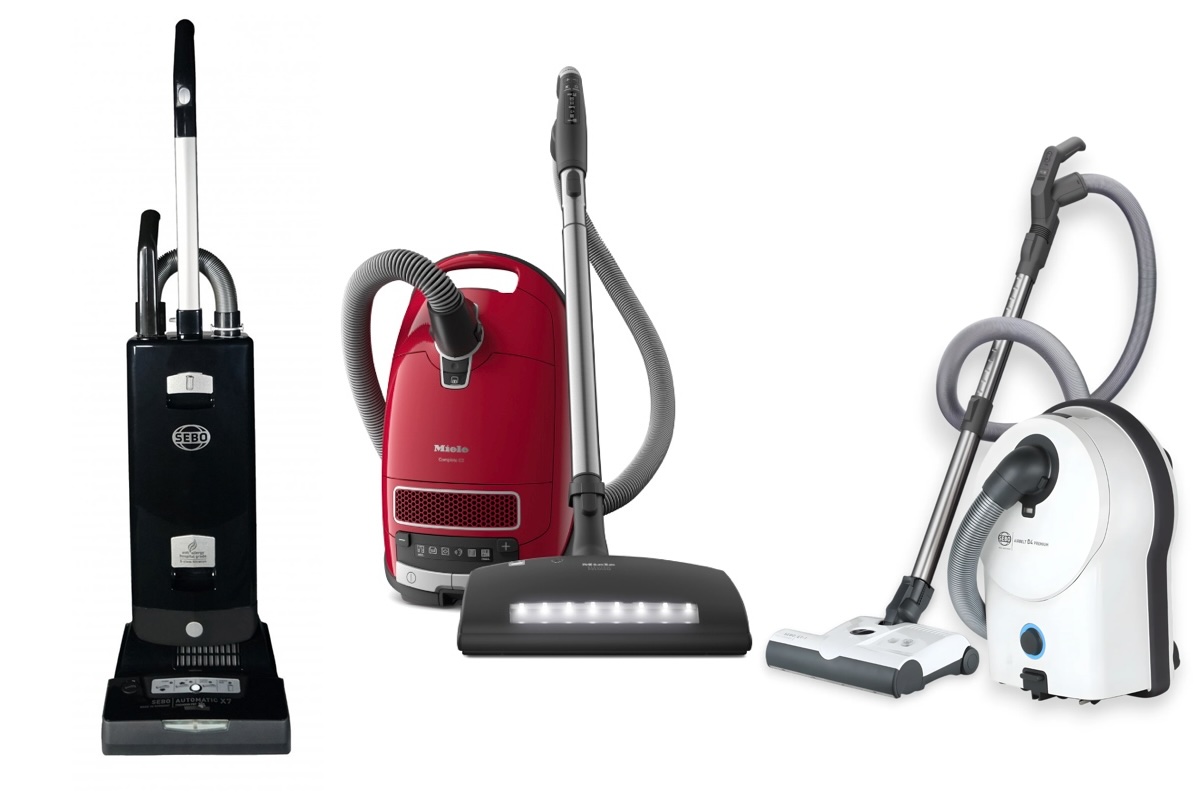
- Sebo’s uprights (Felix, X4, X7, Sebo X8, K series) are where the brand shines, and they’re what most Sebo enthusiasts recommend first.
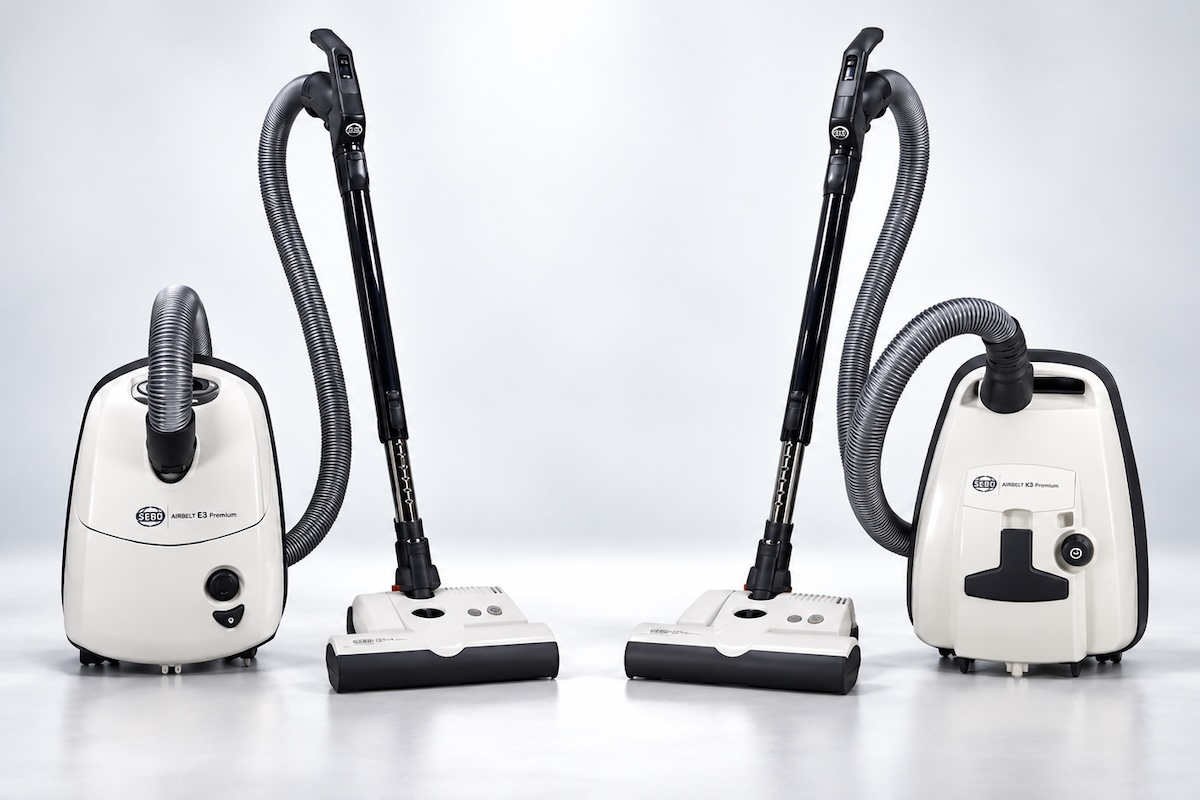
- Sebo’s canisters (D4, D4 Premium, E3) are solid machines that perform well on both carpet and hard floors, though they’re less commonly discussed than the uprights.
- Miele’s canisters (C1, C2, C3 Classic and Complete lines) are the heart of the brand’s reputation and the models most often recommended for mixed-surface homes.
- Miele’s uprights (Dynamic U1 series) are capable machines, particularly for carpeted homes, though they get less attention than the canisters.
If you’re set on an upright, Sebo’s lineup is worth looking at first. If you’re open to a canister, Miele’s C3 line is one of the most well-rounded offerings on the market.
Ease of Use and Day-to-Day Living
Miele
Miele canisters roll smoothly on multi-directional wheels and are lighter than they look. The variable suction adjustment on the handle (on C2 and C3 models) is a thoughtful detail — turning down the power for drapes or picking it back up for carpet without bending down or walking back to the machine is genuinely convenient. Bag changes are clean and quick. The cord rewind is automatic and works reliably. The soft bumper around the canister body protects baseboards and furniture.
One thing worth nothing before you buy: Miele’s C3 Complete line comes in several bundle configurations, each pairing the canister with a different primary floorhead — i.e. an electrobrush for carpet, a parquet brush for hardwood, a combined floorhead for mixed surfaces, and so on. It’s worth spending a couple minutes matching the bundle to your primary floor type before purchasing, rather than defaulting to whichever box is on the shelf. A local brick-and-mortar vacuum store like Edison Vacuum of Nashville can steer you in the right direction immediately, and the Complete bundles are priced to include the floorhead you actually need rather than the cheapest one they could put in the box.
Sebo
Sebo uprights have a reputation for being extremely operator-friendly. The automatic height adjustment removes a variable most people forget to think about. Blockages are easy to diagnose and clear — the machines are designed to be opened and serviced without tools in most cases.
The wand and hose on upright models extend the reach considerably for above-floor work, though for dedicated above-floor cleaning or staircases, a canister is still more practical.
One thing Sebo owners frequently mention is how the machine just feels like it’s working — there’s a mechanical confidence to a Sebo upright that’s hard to describe until you’ve used one. Thoroughly competent in a way that just feels like you can rely on the machine.
Noise Levels
Miele has a well-earned reputation for producing some of the quietest vacuums in the premium segment. The C3 Complete series in particular runs at a sound level that lets you have a conversation at normal volume while the machine is running — something that’s genuinely unusual for a full-size canister. If you have a baby, a light sleeper, or you just dislike the racket that vacuuming usually involves, Miele’s quieter operation is a meaningful quality-of-life improvement.
Sebo uprights are not loud machines — they’re far quieter than most box-store uprights — but they’re not as library-quiet as a Miele C3. The brush roll engagement adds some mechanical noise that’s simply part of how the machine works. For most people this is a non-issue, but it’s worth knowing if noise is a primary concern.
Longevity & Repairability
This is one of the most compelling arguments for either brand, and it applies to both.
Miele builds their motors to survive 1,000 hours of use, which works out to roughly 20 years for a household vacuuming once a week. They back this with a long warranty and a parts and service network that supports older machines — it’s not unusual to find Miele owners running 15-year-old C-series machines that still perform like new because the motors are simply that robust.
Sebo’s longevity is equally strong, and in some ways more visible because of how the machines are designed to be serviced. Sebo uprights are built to be opened, cleared, and maintained without specialized tools or a trip to a service center. Parts — belts, filters, brush rolls, bags — are widely available and inexpensive relative to the machine’s price. The simplicity of the mechanical design means there’s less to go wrong, and what does wear gets replaced easily. There are Sebo machines from the early 2000s still working in professional environments.
Longevity Takeaway: Both brands can be genuine long-term investments. Miele’s sealed, precision-engineered approach tends to minimize maintenance needs. Sebo’s serviceability-first design makes it easier to keep running yourself if something does need attention. Either way, you’re buying a machine measured in decades, not years.
Price Comparison
Like Riccar, both of these brands occupy the premium/high-end vacuum tier, though the entry points and top-of-range models differ somewhat.
Miele Pricing (approximate, USD)
- C1 Classic series: ~$400 — entry-level canisters, solid filtration, basic floorhead
- C2 Compact series: ~$500 — more compact body, improved floorhead options
- C3 Complete series: ~$1,100+ — the flagship canisters, best filtration, widest floorhead selection, quietest motors
- Dynamic U1 uprights: ~$700
Sebo Pricing (approximate, USD)
- Felix series: ~$600 — upright with manual height adjustment, excellent entry point
- Sebo X4 series: ~$700 — automatic height adjustment, broader brush roll
- Sebo X7 series: ~$800 — flagship upright, automatic height, brush roll shutdown, ET-1 or ET-1 power head options
- D4 / E3 canisters: ~$800
At comparable price points, neither brand is objectively better value — they’re both asking for what they’re worth. The question is which machine’s strengths align with what you actually need.
Bags, Consumables, and Running Costs
Both brands use proprietary bags, and both produce quality replacement bags — though this does mean you’re in their ecosystem for ongoing consumables.
Miele bags (FJM/FJM HEPA, GN, Airclean U-style depending on the model) can be very affordable when purchased in multipacks. At average use, most households might go through 6–10 bags per year or less, making annual replacement bag costs rather low. Filters need periodic replacement as well, though the main HEPA filter in C3 models lasts a very long time under normal conditions.

Sebo bags are similarly priced, especially when purchased in multipacks. Their machines also use a motor protection filter that should be checked and replaced annually. The overall consumable cost profile is comparable to Miele.
Pets: Which Brand Handles Animal Hair Better?
Both brands manage pet hair well, and both offer accessories or configurations specifically oriented toward homes with animals.
Miele has the C3 Cat & Dog models that include an active air clean filter (which captures and neutralizes odors, not just particles) alongside their standard HEPA setup. The active carbon filtration layer is a meaningful addition for homes with multiple animals or particularly odor-prone pets. Miele’s mini turbine tool and the electrobrush also do a good job pulling embedded hair out of upholstery and low-pile rugs.
Sebo handles pet hair effectively through sheer mechanical thoroughness — the brush roll agitation in their uprights digs hair out of carpet fibers reliably, and their bags hold it without the airflow issues that cause some vacuums to struggle when the bag fills. The Sebo X7 Premium Pet model comes with a tangle-free brush roll specifically designed to resist wrapping, which is a practical improvement if you have long-haired animals or family members.
Pet Hair Takeaway: For odor control in addition to hair removal, Miele’s Cat & Dog series with active carbon filtration has an edge. For raw pet hair extraction from carpet, Sebo’s upright brush roll engineering is hard to beat.
Who Should Choose Miele?
Miele tends to be the right fit if:
- Your home has a mix of hard floors and carpets, or is primarily hard floors
- Quiet operation is a genuine priority — not just a nice-to-have
- You value a wide accessory ecosystem and the ability to adapt the machine to different tasks
- Allergy management is central to your decision, and you want the best possible sealed filtration
- You prefer a canister design and the maneuverability that comes with it
- Pet odor control, in addition to hair removal, is important to you
- You want something that’s quiet enough to use without disturbing others in the home
Who Should Choose Sebo?
Sebo tends to be the right fit if:
- Your home is predominantly carpeted, especially with thick or high-pile rugs
- You want an upright that handles everything mechanically and requires minimal adjustment
- Longevity and serviceability rank high — you want a machine you can maintain yourself
- You’ve been recommended Sebo by a flooring professional or carpet retailer
- You want professional-grade durability in a residential package
- You’ve had frustrating experiences with uprights that tangle, bog down, or burn through belts
- You prefer straightforward, unfussy design over feature-rich complexity
A Few Less-Discussed Points Worth Knowing
Where They’re Sold
Both Miele and Sebo are reliably purchased through independent vacuum retailers rather than big-box stores. Independent dealers e.g. local vacuum shops tend to carry more of the lineup, can offer proper fitting advice, and typically provide better after-sale support. Miele has somewhat wider availability, but especially for Sebos, finding a knowledgeable independent dealer can make a big difference.
Resale Value
Both brands are built to last a long time, and thus hold resale value unusually well for household appliances. A well-maintained Miele or Sebo from five or six years ago sells on the secondary market at a significant fraction of its original price, which is a testament to how buyers perceive their durability.
Made in Germany
Both Miele and Sebo manufacture their vacuums in Germany. For buyers to whom country of manufacture matters — whether for quality reasons, supply chain preferences, or supporting European manufacturing — both brands deliver on that front without compromise.
Warranty
Miele’s standard warranty on their residential vacuums is typically one year on parts and labor, with a separate multi-year warranty on the motor and casing depending on the model. Sebo’s warranty structure is similar. Both brands are known for standing behind their products beyond the formal warranty period, particularly through authorized dealers.
Final Thoughts: Two Excellent Answers to the Same Question
Miele and Sebo represent 2 slightly different philosophies about what a high-end vacuum should be. Miele puts refinement, versatility, and quietness at the center of the experience. Sebo puts mechanical durability, carpet performance, and serviceability there instead. Neither philosophy is wrong — they’re just optimized for different priorities.
Fortunately, choosing between them isn’t a high-stakes gamble. Either machine will very likely outlast the next 2 or 3 vacuums you might otherwise buy in the same spending window. Both are built by companies that take quality seriously at a structural level — not as a marketing position, but as an operating principle that literally dates back generations.
If you walk into this decision knowing primarily what your floors are made of and what frustrations you’ve had with vacuums in the past, the right answer tends to become obvious fairly quickly. Carpet-heavy home, frustrated with uprights that don’t hold up: look hard at the Sebo X7. Mixed surfaces, want quiet, love accessories: a Miele C3 Complete is probably your machine.
Either way, you’re buying something worth buying.
Bottom Line: Miele is the stronger choice for hard floor versatility, quiet operation, and mixed-surface homes. Sebo is the stronger choice for carpet-heavy homes, professional-grade reliability, and buyers who want maximum mechanical simplicity. Both are among the best and most powerful residential vacuums made anywhere in the world.