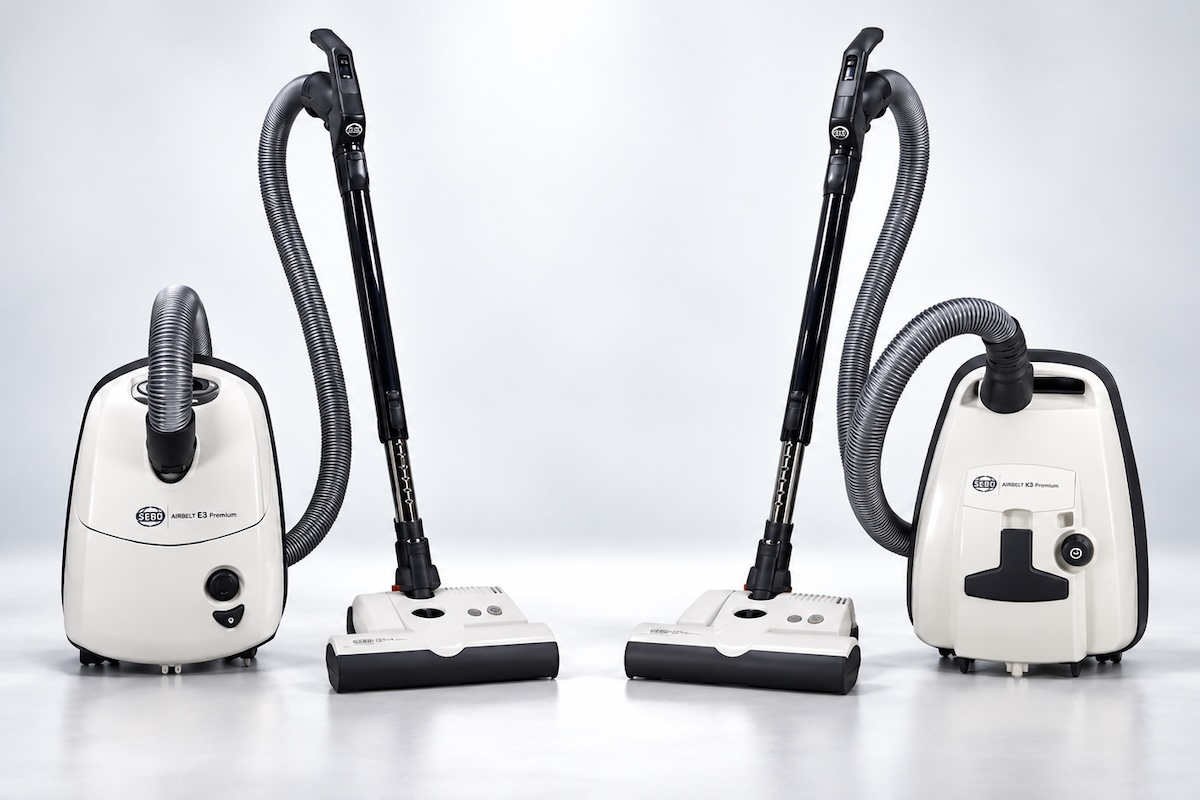
What the E1 and E3 Have in Common
Both canisters come from the same body and the same 1200-watt suction motor, so the family resemblance runs deeper than the badge on the lid. Each one ships with a 0.92-gallon bag, a 25-foot cord, and roughly a 37-foot cleaning radius once the 7-foot hose is factored in. Three onboard tools travel with the canister on every model: a crevice tool, an upholstery nozzle, and a dusting brush.
A soft AIRBELT bumper wraps around the canister on both machines. It cushions bumps into furniture and doorframes, and it also works as a diffuser that softens the exhaust air on its way out, which is part of why SEBO canisters run quieter than many uprights. Three rubber-coated caster wheels on steel axles carry the canister across hard floors without leaving marks, and a full-bag or clog indicator light warns before airflow drops off.
- 1200-watt suction motor, shared across the whole Airbelt E line
- 0.92-gallon (3.5-liter) bag with a hygiene cap that seals during disposal
- 25-foot cord and about a 37-foot cleaning radius
- S-class filtration, a filtration grade rated to capture fine dust down to 0.3 microns
- Push-button cord rewind and a telescopic wand with quick-release connections
- Assembled in Germany
Inside the Airbelt E1 Kombi
The E1 Kombi is the straight-suction model in the lineup. It relies on the canister’s motor alone, with no separate brush motor anywhere in the system.
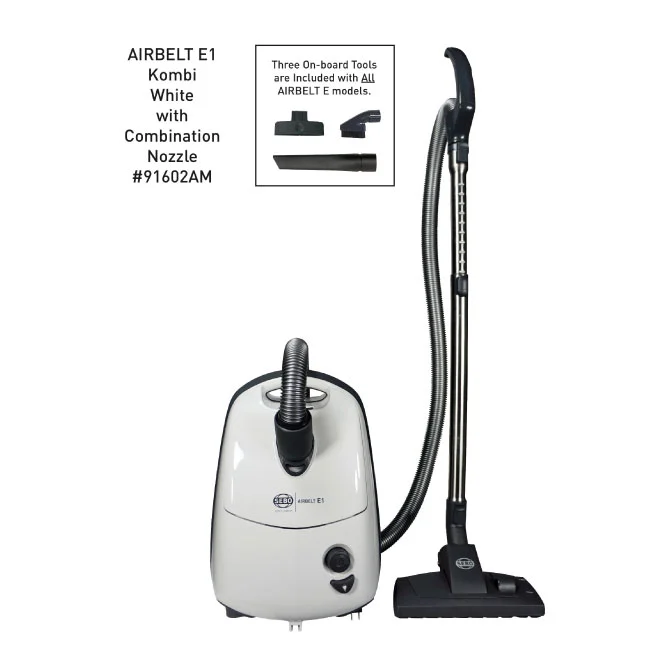
In place of a power head, it uses the Kombi nozzle: a combination tool with a strip of bristles that retracts with a toe-tap switch, so the same nozzle handles bare floors with the bristles down and flat-weave rugs with the bristles pulled back.
Suction is adjusted with a knob on the canister body rather than on the handle, which keeps the E1’s handle simple and light. SEBO rates the E1 at 58 dBA, a decibel reading several points below the E3’s, since there is no brush motor running inside the nozzle. The tradeoff is agitation: the Kombi nozzle lifts loose debris well, but it does not dig into pile the way a motorized brush roll does.
The E1’s hose and telescopic wand carry no electrical wiring, so a power head cannot be added later. Anyone who might want SEBO’s ET-1 head down the road should start with the E2 Turbo or E3 Premium instead of planning to upgrade an E1.
Inside the Airbelt E3 Premium
The E3 Premium adds SEBO’s ET-1 power head, a commercial-quality motorized brush roll built for carpets, area rugs, and hard floors alike. The brush spins at 2700 RPM, has four manual height settings, and can be pulled for cleaning or replacement without tools. A warning light comes on if the roller jams, and the head shuts itself off automatically rather than continuing to run against an obstruction.
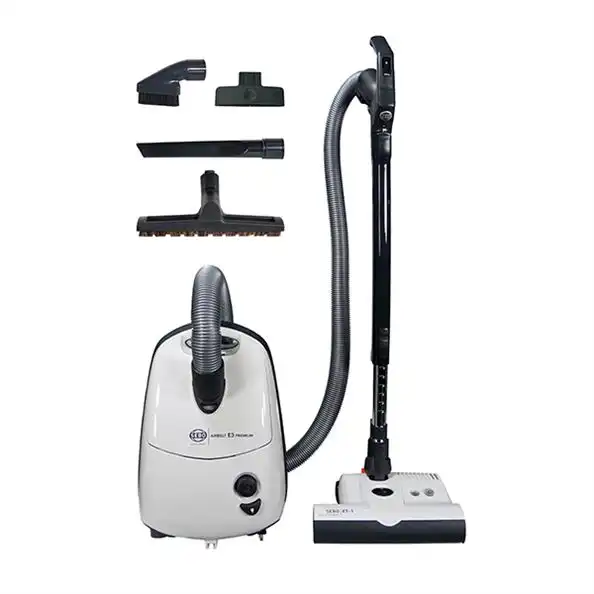
Control moves to the handle on this model. A slider adjusts suction from full power down to a gentle setting for curtains and upholstery, and a separate switch turns the brush roll on and off, so straight suction stays available for delicate rugs. The power head’s flat, 3.5-inch profile and 180-degree steering make it easy to work the wand under toe-kicks and low furniture.
A parquet brush, a soft-bristle tool built for wood, tile, and other hard floors, ships alongside the power head. The E3 also swaps the E1’s straight hose for a tapered, conical one, which speeds up airflow through the tube and cuts down on clogs.
Long-Term Maintenance & Warranty Coverage
The E1’s Kombi nozzle has no motor, no belt, and no brush roll to wear out, so there is little to maintain beyond emptying the bag and clearing the occasional strand of hair from the retractable bristles. That simplicity is part of what keeps the E1 light and quiet.
The E3’s ET-1 power head does more work, so it has more moving parts to look after. The brush roll wears with use, and tool-free removal means checking it for tangled hair, or swapping a worn belt, happens at home instead of at a repair shop. Both machines pull from the same bag supply, so the basic day-to-day task, changing the bag before the indicator light comes on, stays identical across the lineup.
SEBO backs its current U.S. lineup, including the Airbelt E series, with a 7-year warranty on the motor and 5 years of coverage on parts and labor. That warranty applies the same way regardless of which E model is purchased, so the E3’s added power head does not carry separate terms of its own. SEBO has sold vacuums in the United States since 1979, and the company’s canisters are used in hotels, hospitals, and schools alongside residential homes, which is part of why parts and service support tend to stay available well past the first few years of ownership.
Specifications Side by Side
The table below lines up the two machines feature by feature. Rows that match, like bag capacity or cord length, are identical because the E1 and E3 share the same canister platform.
| Feature | Airbelt E1 Kombi | Airbelt E3 Premium |
|---|---|---|
| Suction motor | 1200 W | 1200 W |
| Cleaning head | Kombi nozzle, straight suction | ET-1 power head plus parquet brush |
| Suction control | Knob on the canister body | Slider on the handle |
| Brush roll | None, straight suction only | 175 W motor, 2700 RPM, 4 height settings |
| Hose design | Straight | Tapered, conical |
| Sound level | 58 dBA | 62 dBA |
| Filtration | S-class | S-class |
| Bag capacity | 0.92 gal (3.5 L) | 0.92 gal (3.5 L) |
| Cord / cleaning radius | 25 ft / about 37 ft | 25 ft / about 37 ft |
| Canister body weight | 11.4 lb | 11.4 lb |
| Edison Vacuums price | $649.00 | $1,149.99 |
Noise and Filtration
Both machines use the same S-class filtration system: a multi-layer bag, a pre-motor microfilter, and an exhaust microfilter that catches fine dust before it leaves the vacuum. S-class is a recognized filtration grade for capturing particles down to 0.3 microns, and SEBO markets it as hospital-grade, though the company does not label Airbelt filters as HEPA.
The gap in sound level comes entirely from the brush motor. The E1’s 58 dBA reading, a decibel measurement of noise during normal use, reflects a canister running its suction motor alone. The E3 adds a second motor inside the ET-1 head, which pushes the reading to 62 dBA. Both numbers stay well below the 70-plus dBA range typical of cordless stick vacuums, so either model runs quietly during a video call or next to a sleeping baby.
Matching the Vacuum to the Room
A single canister has to cover every room in the house, so it helps to look at how each nozzle performs surface by surface rather than judging the whole vacuum at once.
The breakdown below covers a common flooring mix: tile or hardwood in the high-traffic areas, area rugs in the living room, and carpet in the bedrooms.
- Kitchens, bathrooms, and entryways: Both nozzles handle hard flooring equally well, since neither needs a brush roll to lift debris from tile, hardwood, or vinyl. The E1’s Kombi nozzle and the E3’s parquet brush are both suction-only tools built for this surface.
- Living rooms with area rugs: A flat-weave or low-pile rug works fine with the E1’s Kombi nozzle in its bristled position. Thicker or shag-style rugs respond better to the E3’s ET-1 head, which agitates the pile instead of skimming across it.
- Bedrooms and dens with wall-to-wall carpet: This is where the two machines diverge most. Straight suction pulls surface debris but leaves ground-in dirt sitting in the pile, while the E3’s motorized brush roll works it loose before the suction pulls it into the bag.
- Stairs and under furniture: The E3’s flat 3.5-inch power head and the E1’s Kombi nozzle both reach low profiles, and the shared 11.4-pound canister body carries by the handle up a staircase on either model.
Choosing Between the E1 and E3
The two machines are built for different floors, so the flooring at home decides which one fits better than personal preference does.
Choose the E1 Kombi if…
The home is mostly hard flooring, tile, or flat-weave rugs, and the priority is the lightest, quietest canister in the lineup without paying for a power head that would go unused.
Choose the E3 Premium if…
There is wall-to-wall carpet, thick area rugs, or pets that shed, and the priority is a motorized brush roll that agitates pile instead of only pulling air across it.
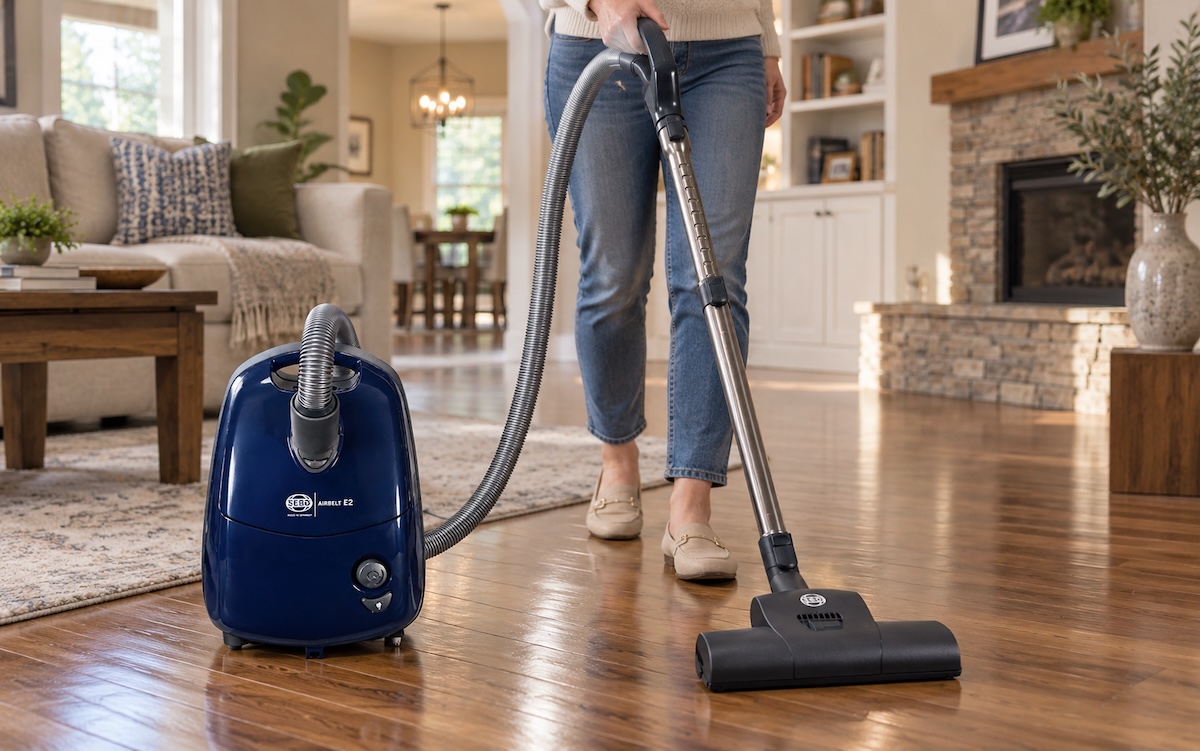
Between these two sits the SEBO Airbelt E2 Turbo, which trades the E1’s Kombi nozzle for an air-driven turbo head that spins from airflow rather than a motor, and adds a parquet brush for hard floors. It lands between the E1 and E3 in both capability and price, and Edison Vacuums carries it at $749 at the time of this writing.
Where the E Series Fits in SEBO’s Lineup
SEBO was founded in 1978 by two engineers in Velbert, Germany, and has sold vacuums in the United States since 1979. The company built its reputation on commercial-grade construction sold into homes, and its canisters and uprights are used in hotels, hospitals, and schools in addition to residential settings.
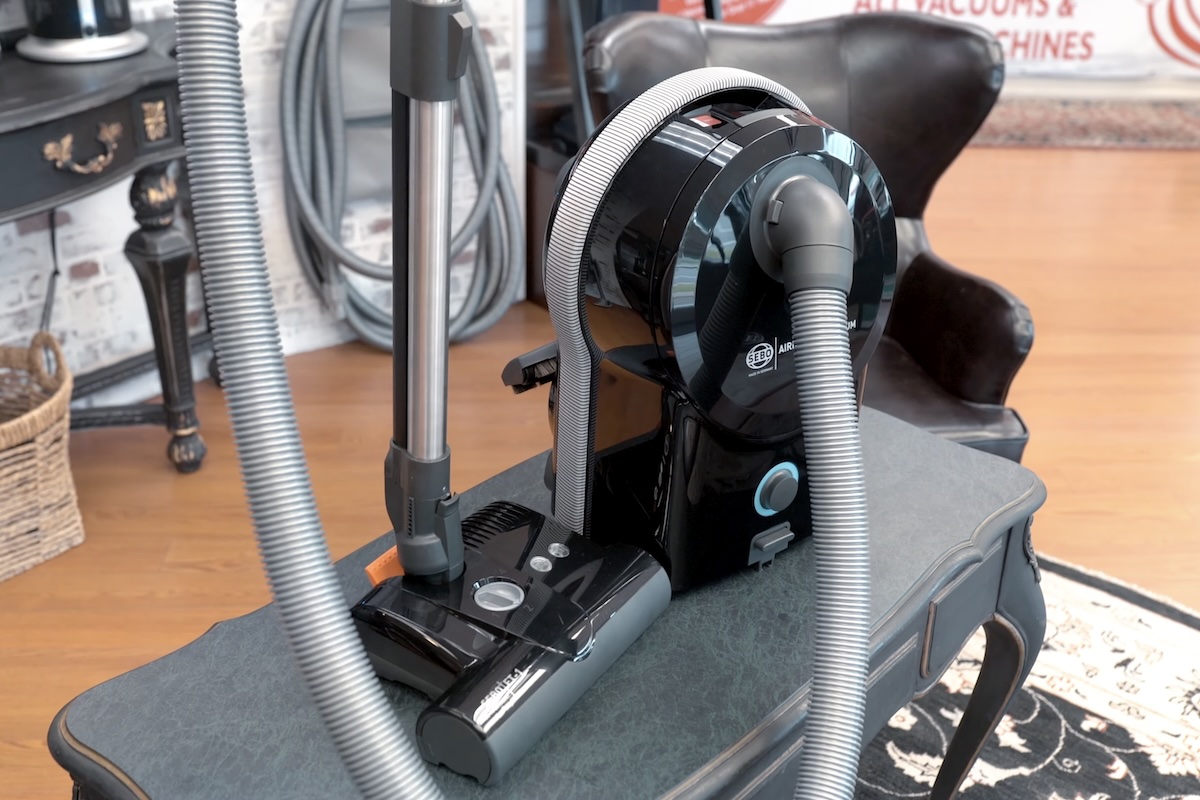
Within SEBO’s own canister lineup, the Airbelt E series sits between the older K series and the larger D series. SEBO carried over airflow engineering from the D series into the E line, smoothing out turbulence inside the canister body, which is part of why the E1 and E2 run at 58 dBA against the K2’s 63 dBA rating. The K series still offers its own straight-suction and power-head options, including the K2 Kombi, K2 Turbo, and K3 Premium, built on a slightly older canister platform. The D series (including the Airbelt D4 Premium, pictured below) is SEBO’s largest canister line, trading some of the E series’ compact size for a bigger bag and longer reach in larger homes.
The K3 Premium and E3 Premium share the same ET-1 power head and similar core electronics, so the two machines clean carpet and hard floors about the same way. The remaining differences sit in the canister itself: the E3 carries a slightly larger 0.92-gallon bag against the K3’s 0.8-gallon bag, along with a different body shape and bumper styling. Shopping SEBO’s full canister catalog usually means picking a body size and bag capacity built around the same core engineering, not choosing between different levels of build quality.
Frequently Asked Questions
Q: Can the E1 Kombi clean carpet?
A: Only flat-weave and low-pile rugs, since the Kombi nozzle relies on suction alone. Thicker pile needs agitation from a brush roll, which the E1 does not have, so the E3 Premium or E2 Turbo fit wall-to-wall carpet better.
Q: Do the E1 and E3 use the same bags and filters?
A: Yes. Both share the same canister body and 0.92-gallon bag compartment, so replacement bags and filters are interchangeable across the Airbelt E lineup.
Q: Which model is quieter?
A: The E1, rated at 58 dBA against the E3’s 62 dBA. The difference comes from the ET-1 power head’s brush motor, which the E1 does not carry.
Q: Is it possible to add a power head to an E1 later?
A: No. The E1’s hose and wand are not wired for an electric power head, so that upgrade is not available after purchase. Buyers who might want one eventually should start with the E2 Turbo or E3 Premium.
Q: How does the E2 Turbo fit between these two?
A: It swaps the E1’s Kombi nozzle for an air-driven turbo head, plus a parquet brush for hard floors, without an electric motor in the head. That puts the E2 between the E1 and E3 in both capability and price.
Q: Is there a weight difference between the two models?
A: SEBO lists the same 11.4-pound body and 1.5-pound handle for the whole E series, since the canister and motor housing are shared. The E3 may feel heavier in use because the ET-1 power head carries its own motor at the end of the wand, while the E1’s Kombi nozzle has none.
Edison Vacuums carries the full Airbelt E lineup, from the E1 Kombi at $649.00 through the E2 Turbo to the E3 Premium at $1,149.99, along with the rest of SEBO’s canister and upright lineup.
Stop by the Brentwood showroom at 202 Wilson Pike Circle to compare the E1, E2, and E3 in person, or call 615-255-3292 during store hours: Monday through Friday from 9 a.m. to 3 p.m., and Saturday from 10 a.m. to 2 p.m.