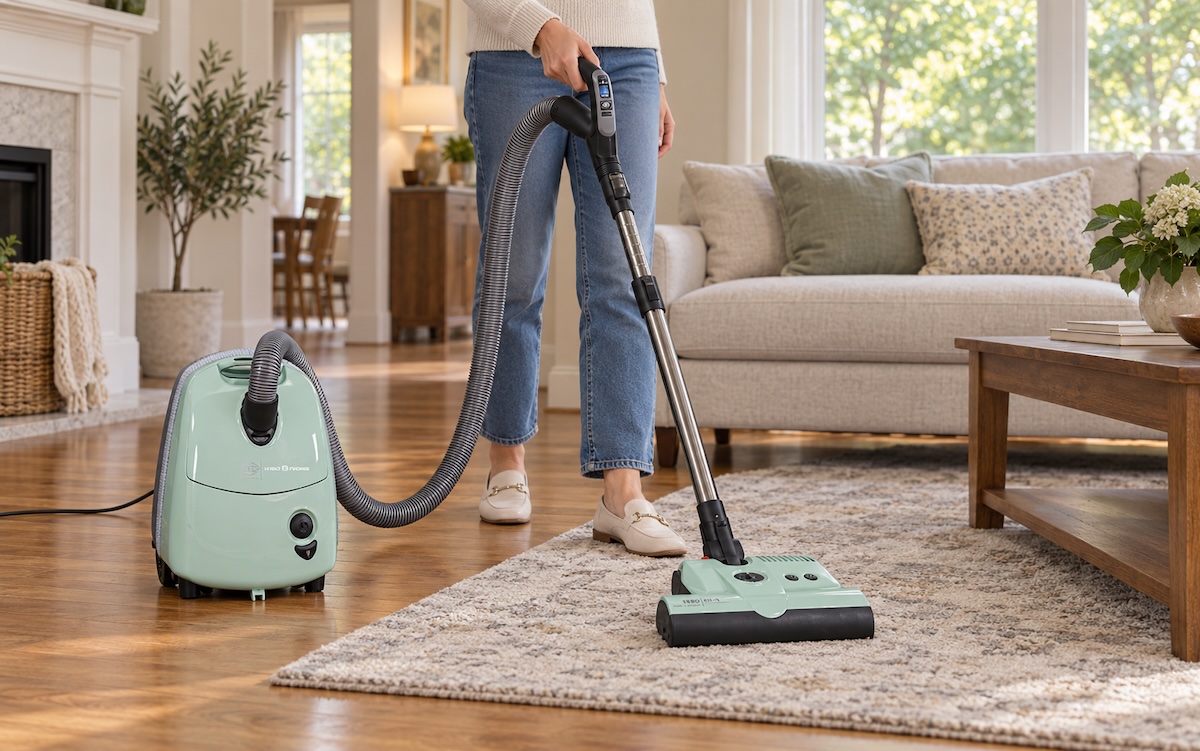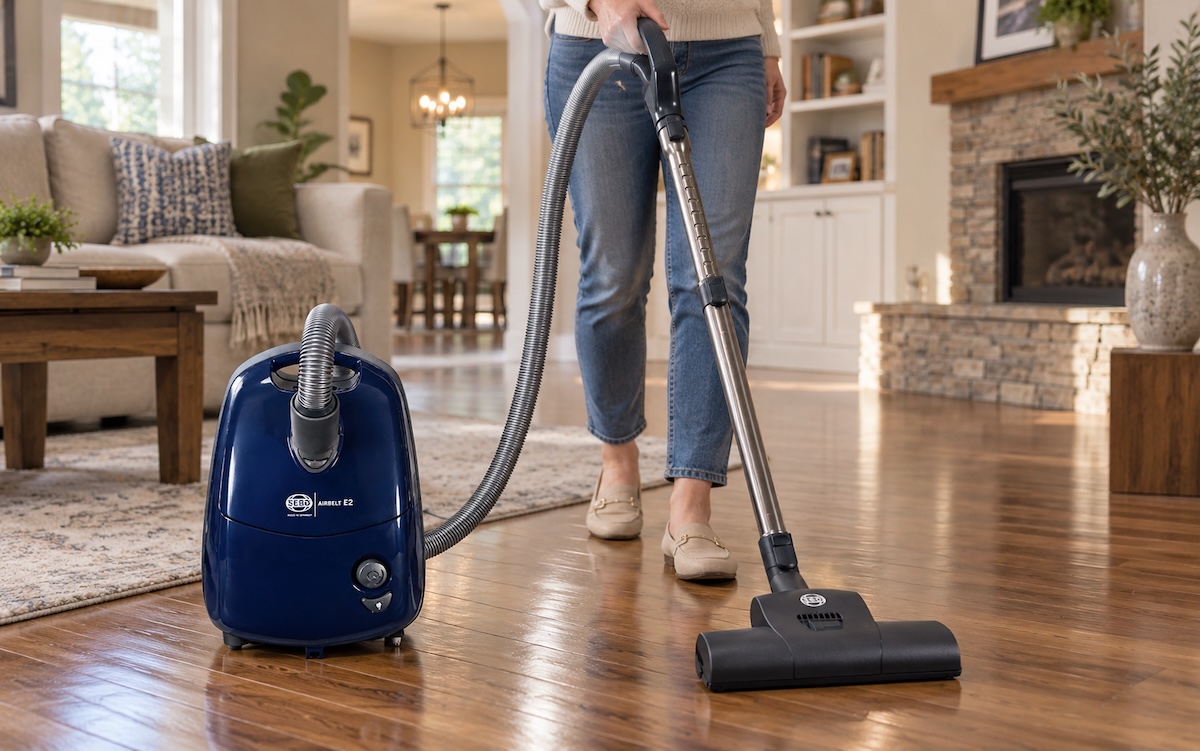
The Airbelt E1 Kombi and E2 Turbo run on the same 1200-watt motor, the same canister body, and the same 0.92-gallon bag. So, the difference between the SEBO E1 and the E2 is the floor tool on the end of the hose.
The E1 comes with a single combination nozzle that cleans both hard floors and rugs. The E2 splits that job between two tools: an air-driven turbo head for low- to medium-pile rugs and a parquet brush for hard floors. The third model in the series, the E3 Premium, adds a motorized power head, and our SEBO Airbelt E1 vs E3 comparison covers how it compares with the E1.
Table of Contents
ToggleWhat the SEBO E1 and E2 Have in Common
Both machines are straight-suction canisters, meaning neither one has an electric motor built into the floor tool. All of the cleaning power comes from the 1200-watt motor inside the canister itself, and that motor, along with the bag, the filtration system, and the body it all sits in, is identical between the two models.
SEBO rates both the E1 and E2 at 58 dBA. The E2’s turbo head has no motor to add noise, and the hose and wand on both models carry no power cord, which is also why neither one can run an electric power head. The E3 Premium, which does run one, is rated at 62 dBA.
- 1200-watt suction motor, with no motor in either floor tool
- 0.92-gallon (3.5-liter) bag, shared with the rest of the Airbelt E line
- Three-stage filtration: a pre-motor filter, a three-layer bag, and an S-class exhaust microfilter
- Sound level of 58 dBA on both models
- Suction control knob on the canister body, not the handle
- 25-foot cord and about a 37-foot cleaning radius
- 11.4-pound canister body
The above-floor attachments match as well. Both models carry the same three tools on the canister: a crevice nozzle, an upholstery nozzle, and a dusting brush. They also share the 7-foot hose, the telescopic wand with quick-release connections, the soft AIRBELT bumper, and the full-bag or clog indicator. That narrows the attachments question considerably: every above-floor tool is identical, and only the floor tools change.
SEBO uses this same split across its canister lineup as well. The K2 Kombi and K2 Turbo carry an identical distinction, a combination nozzle on one and an air-driven turbo head with parquet brush on the other, built on SEBO’s K-series canister platform. In both series, the name describes the floor tool that comes in the box.
How the Cleaning Heads Differ
The E1 Kombi comes with a single floor tool: the Kombi nozzle. It’s a combination head with a strip of bristles that retracts with a toe-tap switch, so the same nozzle handles bare floors with the bristles down and flat-weave rugs with the bristles pulled back. Nothing inside it spins. It’s a suction-only tool that relies entirely on the canister’s motor to pull dirt loose.
The E2 Turbo replaces that single nozzle with two separate tools. The turbo head is built for low- to medium-pile rugs: a turbine inside the nozzle spins a brush roll using the vacuum’s own airflow, so it agitates rug fibers without an electric motor or any wiring running down the wand. A dedicated parquet brush handles hardwood, tile, and other hard floors.
That’s the full extent of what changes. It’s fair to call it an attachments difference, since nothing about the motor, bag, or filtration is touched. But the turbo head isn’t merely a cosmetic swap, either. A spinning brush roll, even an air-driven one with no motor, works dirt out of carpet fibers in a way a static bristle strip cannot. The Kombi nozzle pulls dirt off the surface, and the turbo head works some of it loose first.
A turbo head runs on the same airflow that carries dirt into the bag, so spinning the brush roll uses some of that airflow. Any air-driven nozzle works this way.
The tradeoff shows up in upkeep, too: The Kombi nozzle has nothing inside it to clean, since the bristle strip doesn’t move. The turbo head’s brush roll does move, so thread and long hair can wrap around it over time the same way they would on any spinning brush, even one with no motor of its own. It needs clearing from time to time, which is one more part to check than the E1 has.
Performance on Hard Floors & Rugs
On hard flooring, both machines clean with a suction-only tool: the Kombi nozzle with its bristles down on the E1, and the parquet brush on the E2. Wood, tile, and other hard floors have no pile to work into, so neither one needs a spinning brush there.
Rugs are where the two floor tools split. With its bristles retracted, the E1’s Kombi nozzle suits flat-weave and low-pile rugs and relies on suction alone to pull dirt from a short pile. The E2’s turbo head is built for low- to medium-pile rugs. Its air-driven brush roll works into the fibers and loosens dirt that suction by itself can leave behind.
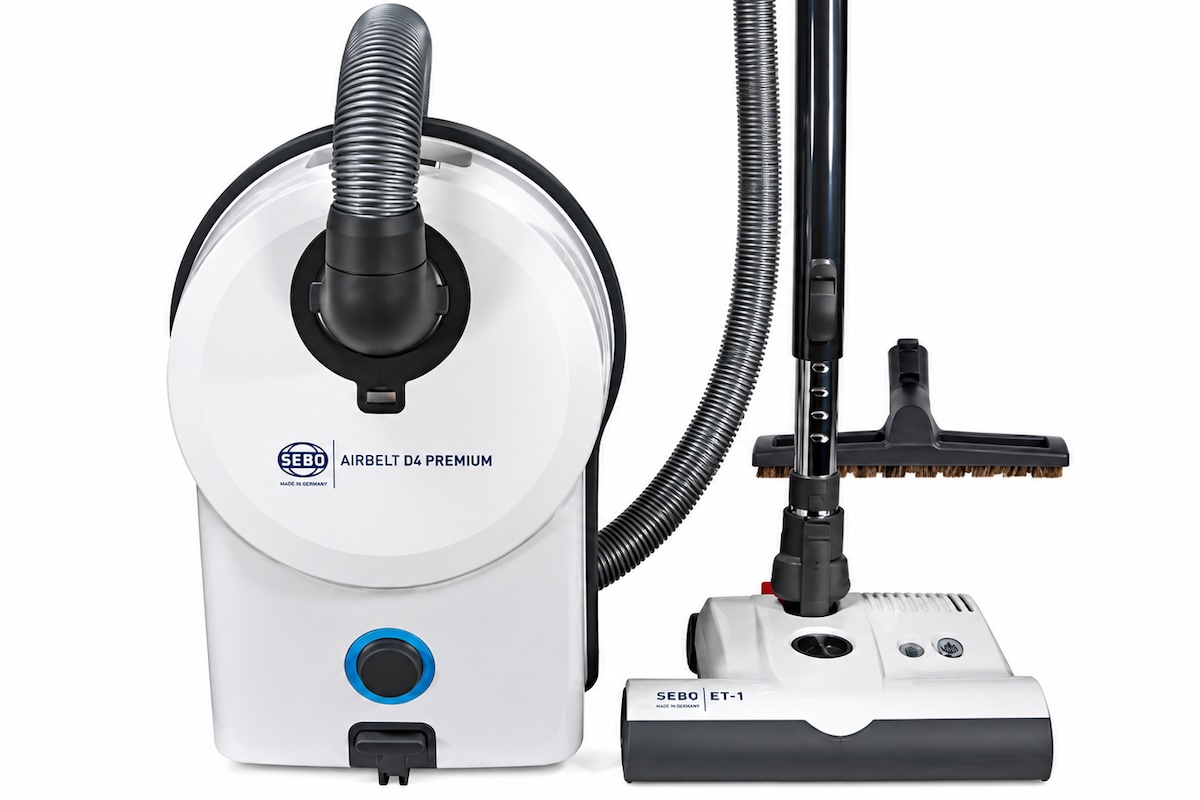
Carpet follows the same pattern. Low-pile carpet works with either machine, and the E2’s turbo head covers medium pile as well. Thick or plush carpet calls for the ET-1 power head that comes with the Airbelt E3 Premium. Its brush roll runs on its own 175-watt motor at 2,700 RPM, with four height settings, so it keeps working deep pile without drawing on the vacuum’s airflow.
Specification Comparison Side-by-Side
The table below lists every spec that could plausibly differ between the two models. Most of them don’t.
| Feature | Airbelt E1 Kombi | Airbelt E2 Turbo |
|---|---|---|
| Suction motor | 1200 W | 1200 W |
| Floor tools included | Kombi nozzle (1 tool, both surfaces) | Turbo head plus parquet brush (2 tools) |
| Motor in the floor tool | None | None (air-driven turbine) |
| Suction control | Knob on the canister body | Knob on the canister body |
| Sound level | 58 dBA | 58 dBA |
| Filtration | S-class | S-class |
| Bag capacity | 0.92 gal (3.5 L) | 0.92 gal (3.5 L) |
| Cord / cleaning radius | 25 ft / about 37 ft | 25 ft / about 37 ft |
| Canister body weight | 11.4 lb | 11.4 lb |
| Edison Vacuums price | $649.00 | $749.00 |
Price Difference Between the E1 and E2
At Edison Vacuums, the E2 costs $100 more than the E1. Everything else on the spec sheet is identical, so that $100 pays for the turbo head and the parquet brush. A few factors point toward one model over the other.
Homes with mostly hard flooring and a couple of flat or low-pile rugs get little practical benefit from the turbo head, since the Kombi nozzle already covers that combination. Homes with medium-pile area rugs, or with pets that shed onto those rugs, get more out of the E2’s spinning brush roll, since it reaches into pile that suction alone tends to skim over.
The parquet brush ships only with the E2 and E3, not the E1, so anyone who wants a hard-floor tool that’s separate from the multi-surface Kombi nozzle picks that up as part of the E2’s price rather than as an add-on purchase later.
There’s also a practical case for buying the extra capability upfront. Trading up from an E1 to an E2 later means finding a buyer or storage space for a vacuum that still works fine, while starting with the E2 costs $100 more today and settles the question for both floor types from day one.
Wall-to-Wall Carpet and the E3 Premium
Both the E1 and E2 are straight-suction machines, and both will clean carpet. The E2’s turbo head handles low- and medium-pile carpet well for regular upkeep, and the E1’s Kombi nozzle, with its bristles retracted, picks up surface dirt.
What neither has is an electric power head, which is what reaches down into thick or plush carpet, where dirt settles deep in the pile. SEBO’s answer to that is the Airbelt E3 Premium, which trades the E2’s air-driven turbo head for a commercial-quality ET-1 power head with its own brush motor. The tradeoff is a higher price and a sound rating of 62 dBA against the E2’s 58, in exchange for a brush roll that agitates carpet electrically instead of relying on airflow alone.
Frequently Asked Questions (FAQ)
Q: Are the SEBO E1 and E2 the same vacuum?
A: The canister, motor, bag, and filtration are identical. The floor tools are not: the E1 comes with a single Kombi nozzle, and the E2 comes with an air-driven turbo head plus a separate parquet brush.
Q: Is the turbo head electric?
A: No. A turbine inside the nozzle spins the brush roll using the vacuum’s own airflow. The E2’s hose and wand carry no power cord, and SEBO rates it at the same 58 dBA as the E1.
Q: Can I add a turbo head and parquet brush to an E1 later?
A: Buying the E2 Turbo is the most direct route, since it comes with both from the factory. SEBO sells some tools and parts individually, and Edison Vacuums carries a number of them, so anyone curious about fitting a specific attachment to an E1 should call the shop to check compatibility before ordering one on its own.
Q: Which one is better for pet hair?
A: On rugs, the E2’s turbo head has an edge, since the spinning brush roll works pet hair out of the pile instead of relying on suction alone. Hard floors perform about the same either way.
Q: Do the E1 and E2 use the same bags and filters?
A: Yes. Both share the same 0.92-gallon bag compartment and S-class filtration system, so replacement bags and filters are interchangeable across the two models.
Q: Which model is quieter?
A: SEBO rates both vacuums at 58 dBA, since neither floor tool has a motor. The E3 Premium, with its motorized ET-1 head, is rated at 62 dBA.